 Bike Stories
What a bike actually costs per kilometre, and how to work yours out
A commuter bike's running cost is a handful of cents per kilometre. At US street prices, a 3,000 km year costs about $260 across the line items that wear, chain, tyres, tubes, the small stuff and labour, which divides to roughly 9c a kilometre. The exact figure is yours to work out from your own prices and distance.
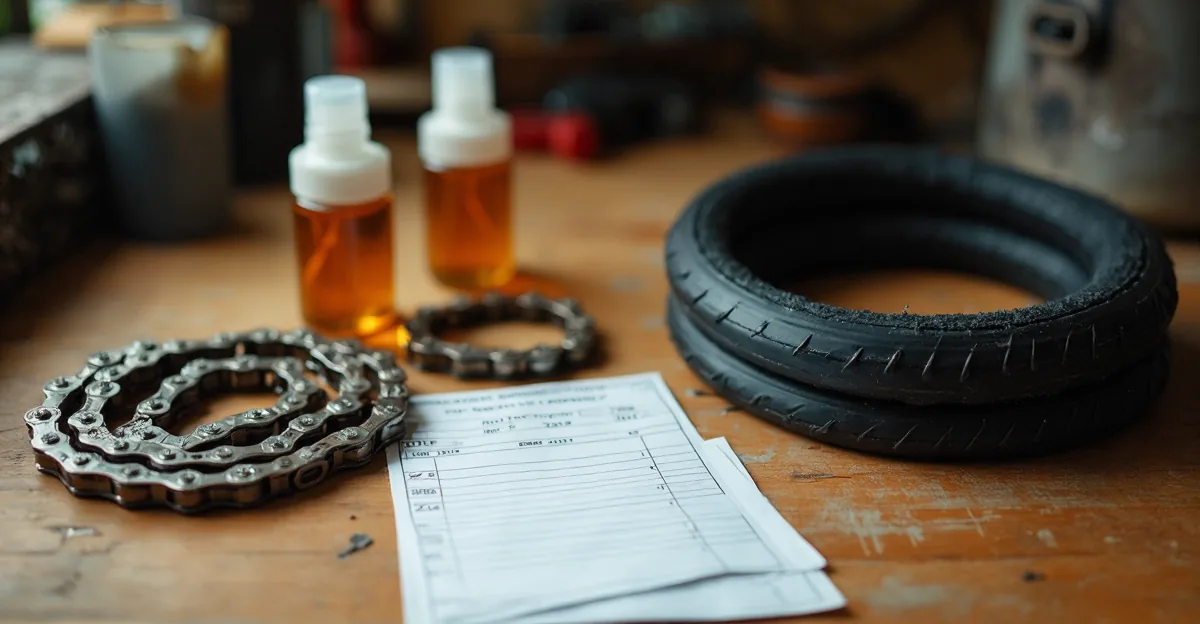
Keeping a bike on the road costs money, and that cost is small and it sits in a handful of line items. The question underneath is the one people ask when they budget for a bike: what does it actually cost to keep riding, and which of it is worth the money?
The short answer: a commuter bike costs a handful of cents per kilometre to run, and cost per kilometre is the parts and labour you spent, divided by the distance you actually rode.
The number, worked out
Take a commuter on a hybrid riding 3,000 km (about 1,900 miles) a year, at US street prices. The working parts are a chain at about $25, a pair of 700x35 tyres at about $70, a few tubes at about $36, and the small stuff, lube and pad inserts, at about $30.
Add two shop visits at about $50 each and the year costs about $261. Divided by 3,000 km, that's roughly 9c per kilometre, or 14c per mile.
That's the answer, and it's a template. Plug your own prices and distance into the same five lines and you get your number. The rest of this post is what moves that number and where the money is worth spending.
The line items, one by one
Chain. The most predictable, because the failure is measurable. A chain checker reads the wear: replace at 0.5% on an 11- or 12-speed and 0.75% on 8-10 speed. Don't wait past the limit to save the part's price, because the cassette and chainring wear with it and the bill stops being a $25 chain.
Grit riding inside the old lube is what wears the pins, so the cleaning interval that fits your conditions matters as much as the chain itself; that one is in our chain lube guide. US street prices for a 9- to 11-speed chain run $15-45, with e-bike versions at or above the top of that range.
Tyres. The biggest single parts purchase. A pair of 700x35 commuter tyres runs $30-60 each at US shops, and a pair is usually a once-a-year line. Road surface, pressure and whether you park against poles all move how long they last.
Tubes. The small line and the one least worth planning. Punctures cluster with road debris, the winter season and worn casings, so the count is hard to predict, but a 700c tube costs $8-15 and the yearly total stays small.
The small stuff. Lube, cleaner and pad inserts. A few dollars of lube and a pair of pad inserts at $5-10 keep the chain quiet and the brakes working, and the yearly total is about $30.
Labour. The most movable line. A shop visit runs $50-100 at a typical US shop. A chain checker, a floor pump and a hex set cost a one-off amount and take several of those visits off the counter; the tool side of that decision is the tool post. Where you draw the line between home work and shop work is the decision that moves the per-km figure most.
What moves the number
The wear parts, chain, tyres and tubes, cost about the same per kilometre whether you ride 3,000 or 5,000, because they wear with the distance. Ride more and you simply buy more of them. What falls with more riding is the labour line: the shop visits are a fixed number for the year, so spreading two visits over 5,000 km instead of 3,000 lowers the per-km cost a little, and not much more.
Three things move the figure more than distance does. Whether you fit the parts yourself or pay a shop, the swing from near zero to a hundred dollars. The conditions you ride in, because grit and salt wear the chain and pads faster and shorten the cleaning cycle. And the drivetrain, because an e-bike loads the chain and cassette harder and wears them sooner.
The example prices are US street prices. Buy where you live and the figure changes, but the method is the same everywhere.
What the number does not include
Three things fall outside the per-kilometre figure, and mixing them in muddies it.
The purchase price. That is what the bike cost to own. If you want it in the number, divide the price by the total kilometres you expect to ride over its life; you pick that life figure, so the result is only as solid as the pick.
Gear and upgrades. Lights, a new saddle and a second wheelset are upgrades to the bike, and they belong in the budget, not in the per-km figure.
The e-bike battery. The battery is a consumable with a price, but it's one event in the bike's life, not an annual line. Amortising it over the expected total distance is a different calculation from the five lines above.
Which parts are worth paying more for
Not every line rewards a bigger bill. Spend where the part fails often or protects something expensive; save where it is small and replaceable.
A chain is worth a real price. The cassette behind it is far more expensive than the chain that wears it, and a chain that holds to the wear limit is the one that protects it. The cheap chain that wears out early ends up costing more, so the saving on the part is not a saving. An e-bike chain sits at the top of the price range because the motor loads it harder, and the premium is doing its job.
Tyres are worth a real price. The biggest single parts purchase is also the one you feel every ride, and a tyre with puncture-protection layers is the one that reduces flats and holds its tread. Save money on the tube, which is a $9 part and a $9 job.
The rule is not quality everywhere, it is quality where the part is the reason the rest of the bike survives.
How to keep the number
The method only works if the two yearly numbers get written down, because a running total of spend and a running total of distance are hard to reconstruct from memory. The options, fairly:
A notebook, or a sticker on the seat tube with the last odometer reading. Free, and it holds the whole method. A spreadsheet is also free and does the division for you if you would rather not do it by hand.
The dedicated log apps take it further. ProBikeGarage is $3.99 to download on iPhone and free on Android, with an optional Premium at $2.99 a month or $24.99 a year; it sets maintenance intervals by distance, time or ride count and syncs rides from Strava.
Fettle is free and leans on its own UK workshops, tracking component mileage and the full service history and booking a service at a workshop. (Both checked in the App Store, November 2026.) Both do more than a cost log, and both track the parts and the distance this method needs.
Bike Stories is one more way to do it: it keeps a log of the expenses, parts and ride distances for each bike, and it is free for two bikes; the Pro unlock, a one-time $9.99, adds unlimited bikes. A notebook is still enough. The log gets you what memory does not, which is the number, written down at the moment you spend the money.
The short version
At the start of the year, write the odometer distance down. As the year goes, add each parts and labour bill to a running total and keep the distance total current. At the end, divide the spend by the distance. The number will land a handful of cents per kilometre on a self-maintained commuter bike, and the useful question is what moved it, not whether it beats anybody else's.
Common questions
What does it cost to run a bike per kilometre?
The running cost is the parts that wear plus the labour. Worked on a commuter riding 3,000 km a year at US street prices, that is about $260 a year, roughly 9c per kilometre or 14c per mile. It moves with how much you ride (the chain, tyres and tubes cost about the same per kilometre at any distance, while the fixed shop visits spread thinner) and with whether you do the parts yourself or pay a shop.
Is an e-bike more expensive to run than a regular bike?
Yes, on two lines. The motor loads the drivetrain harder, so the chain and cassette wear out sooner and that line costs more per year. And the battery ages with use, so a replacement, which can run to several hundred dollars, is a one-off to budget for at some point in the bike's life. The tyre and tube lines are close to a regular bike, and labour per visit is a similar order.
Is shop labour the biggest part of the cost?
It is the most movable line. In the worked example the two shop visits total $100 against about $160 of parts, but only because two of the jobs went to the shop. Fit the parts yourself and the labour line drops to near zero; send everything out and it can pass the parts. It is the one to decide before the first shop visit.
What do I need to track to get my own number?
Two numbers and a division. Add up the parts and labour you paid for in the year, add up the distance you rode in the year, and divide the first by the second. You don't need the odometer at every purchase to get the yearly figure; a running total of distance is the one thing that's hard to reconstruct after the fact.
Drafted with AI, then reviewed and edited by Robert Jensen before publishing.
Stop guessing when you last did that
Bike Stories keeps the service history, the parts, the mileage and the real cost of every bike you own — on your iPhone, with no account. Free for two bikes; Pro is a one-time $9.99 unlock.

Keep reading
Bike tools worth owning, and what each one saves you
You don't need a tool wall. Five tools cover almost every job a home mechanic faces: a floor pump with a gauge, a hex and Torx driver set, a chain checker, a puncture kit, and a torque wrench for the jobs where a stripped bolt is worse than a slow one. The rest are convenience.
Chain lube: wet, dry, wax, and which one your conditions actually want
There is no universal chain lube. The decision is made by two things — whether the chain meets water, and whether it meets grit — and the wax crowd is right about most of it, wrong about most of the rest.