 Bike Stories
Bike tools worth owning, and what each one saves you
You don't need a tool wall. Five tools cover almost every job a home mechanic faces: a floor pump with a gauge, a hex and Torx driver set, a chain checker, a puncture kit, and a torque wrench for the jobs where a stripped bolt is worse than a slow one. The rest are convenience.
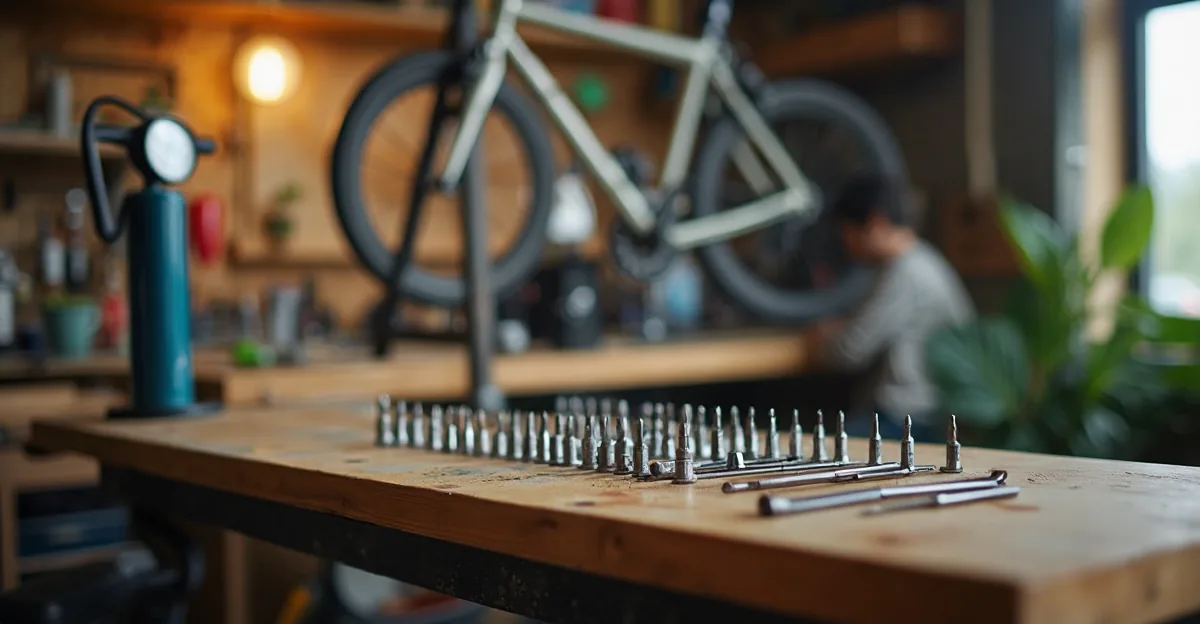
The question underneath a budget toolkit is simple: which tools are worth owning, and what does each one replace? The answer is a short list, and it stays short because the jobs a bike throws at you repeat. A flat, a worn chain, a loose bolt, and a stretched brake cable. Do those and you have done most of the work a home mechanic does.
The other question, from someone building a space on a budget, is the same: what do I need before I start buying? What follows ranks each tool by what it saves you, a shop visit, an expensive part, or a safety margin, so you can stop at the line that fits your budget and your bike.
What the tools actually buy you
You own a tool for one of three reasons. It prevents a shop visit, because you can do the common job at home. It protects an expensive part, such as a cassette or a carbon frame. Or it is a safety job where the right answer is a specific setting, not tight enough.
Five tools clear that bar, and here is what each one saves:
- A floor pump with a gauge saves a shop visit for every low or flat tyre.
- A hex and Torx driver set saves a shop visit for the everyday small jobs.
- A chain checker saves the cassette and chainring from an over-stretched chain.
- A puncture kit saves a shop visit, or a ride home, when the flat is at home or on the road.
- A low-range torque wrench saves a carbon part from a bolt that is too tight.
Everything past the first five is convenience, and buying it comes down to what your time is worth. The one exception worth naming early is work on brakes and steering: when the right answer is a shop, no tool in your kit changes that.
The five tools worth buying first
1. A floor pump with a gauge
A floor pump with a pressure gauge is the tool you use most, and the one that keeps you from riding to a shop on a low tyre. The gauge matters because the sidewall range on the tyre is a window, and the right pressure sits somewhere inside it for your weight and your surface. A sturdy pump with a gauge runs $30 to $50 on the US street.
It saves you the walk to the shop for the most common complaint, and it's the tool that makes a tyre change a ten-minute job.
2. A hex and Torx driver set
Most of the small jobs on a bike come down to a hex or a Torx bolt, whether it's the stem, the handlebar clamp, or the brake lever. A set of the common sizes, 4 to 6 mm hex and T25 to T30 Torx, covers the everyday work, and a basic set is $15 to $30.
This is the tool that turns a "I will take it to the shop" job into a "I will sort that" job, because the loose-bolt class of problems is where home mechanics start.
3. A chain checker
The chain checker is the tool that protects the most expensive part of the drivetrain, the cassette, from the cheapest one, the chain. Park Tool's limit is 0.5% for an 11- or 12-speed chain and 0.75% for 10 speeds or fewer; a single speed can run to 1.0%. The gauge is a go-no-go check on pin elongation, the thing riders call chain stretch. It does not measure how much metal has worn off the pins or rollers. A worn chain doesn't announce itself until the shifting gets sloppy.
A ruler does the same job across 24 rivets, which should span 12 in (305 mm) on a new chain. About 1/16 in (1.6 mm) past the mark is the 0.5% point. Check in a few spots, because wear is not even around the loop.
A chain that runs past its limit reshapes the teeth of the cassette, and a fresh chain then skips on the reshaped cogs. That is the cassette-and-chainring post turned around: the checker is what stops a cheap chain from becoming an expensive set. On an e-bike the mid-drive motor loads the chain harder, so the same check comes up more often. A clean, properly lubed chain wears slower, and the chain-lube post is where the lube choice for your conditions is.
A maintenance log makes this check honest instead of remembered. A notebook with the fit date and the odometer works, and a tool like Bike Stories tracks the distance since the chain was fitted and reminds you when to look. It counts distance; it does not measure the chain, so the checker is still the deciding tool.
4. A puncture kit
The puncture kit is tyre levers, a spare tube, patches, and a little glue, and it costs $10 to $20. It's the reason a flat is a ten-minute job at home or on the side of the road instead of a ride home or a shop visit.
If you ride tubeless, the kit still earns its keep, because a flat is a flat. The hard-to-seat tyre post covers the mounting part that trips people up. Keep the kit with the pump, because you will want them in the same hand.
5. A torque wrench for the low end
A torque wrench is the one tool where "tight enough" is a real risk. Carbon components carry a torque spec, whether it's the stem, the saddle clamp on a carbon seatpost, or the handlebar into a carbon fork. A bolt that's too tight can crack a carbon part or strip a thread. A bolt-on wheel axle is a much higher torque job, 40 to 60 Nm, and sits outside the range of the tools below.
A beam or a low-range ratcheting wrench that reaches about 14 Nm (about 10 ft-lb) covers the carbon jobs above and runs $45 to $115 on the US street. Use the spec on the part, not a number from memory. A torque wrench makes the bolt right; an uncertain brake bleed or fork adjustment stays a shop job.
The tool, the job, and the money it saves
| Tool | Job it handles | What it saves you | Street price (US) |
|---|---|---|---|
| Floor pump with gauge | Inflation, seating a tyre | A shop visit for every flat | $30 to $50 |
| Hex and Torx driver set | The everyday small jobs | A shop visit for minor work | $15 to $30 |
| Chain checker | Reading chain wear | A worn cassette and chainring | Around $13 |
| Puncture kit | A flat, at home or out | A shop visit, or a ride home | $10 to $20 |
| Torque wrench (low range) | Carbon and critical bolts | A cracked part or a stripped thread | $45 to $115 |
The first five together run $113 to $228 at these US street prices, and they cover the jobs that come up most often. A local shop or store will price the same tools differently, and that spread is normal.
When to buy the rest
The rest of the kit is bought at the moment a job becomes routine, not before. A chain whip and a cassette lockring tool, together around $30 to $40, matter only when you change a cassette, and until then they sit unused. A spoke wrench, $10 to $30, matters when you true a wheel or build one.
A repair or wheel stand, $50 to $200, earns its cost once a week, and even then only for the jobs it speeds up. Buy each of these at the job, and the ones that never come up you can leave unbought. That is the whole budget strategy: match the tool to the job, and let the jobs decide the order.
What to skip
A bit case that holds a couple of hundred drivers earns its shelf space in a shop that does other people's bikes. For your own bike it is a drawer of tools you will reach for twice a year. A full ratcheting torque set is not needed when a beam wrench to 14 Nm covers your carbon work. A high-end truing stand is a tool for a wheel you do not plan to build or frequently true.
The test is always the same: does the tool prevent a shop visit, save a part, or protect a safety margin, and does the job actually come up on your bike? If it cannot answer all three, it is a convenience, and a convenience you can buy later or never.
The short version
- Buy first: a floor pump with a gauge, a hex and Torx set, a chain checker, a puncture kit, and a low-range torque wrench.
- Check the chain at the 0.5% limit for 11/12-speed, 0.75% for 10-speed or fewer, and 1.0% for a single speed, and more often on an e-bike.
- Use the part's torque spec, and send an uncertain brake or steering job to a shop.
- Buy the rest at the job: a chain whip and lockring tool for cassettes, a spoke wrench for wheels, and a stand once a week.
- Skip the big bit case, the full torque set, and the truing stand until the job makes them necessary.
Common questions
What bike tools do I actually need to start?
Five. A floor pump with a gauge, a hex and Torx driver set, a chain checker, a puncture kit, and a low-range torque wrench. The first two handle the everyday jobs, the chain checker protects the cassette, the puncture kit fixes the most common failure at home, and the torque wrench covers the carbon and critical bolts. Everything else waits until you hit the job it is for.
What is a chain checker really measuring?
Pin elongation, the thing riders call chain stretch. It is a go-no-go gauge, not a thickness measurement. Park Tool's limit is 0.5% for an 11- or 12-speed chain and 0.75% for 10 speeds or fewer (1.0% for a single speed). A ruler does the same job across 24 rivets, which should span 12 in (305 mm) on a new chain. Check in a few spots, because wear is not even, and check more often on an e-bike, where the motor loads the chain harder.
Do I need an expensive tool set, or are cheap tools enough?
Cheap is fine for the first kit, if you buy the right tools rather than a big case of the wrong ones. A basic floor pump, a modest hex and Torx set, a chain checker, and a puncture kit together run $70 to $115 at US street prices, so the first kit is one purchase, not an ongoing expense. The place where cheap genuinely fails is a torque wrench for carbon and critical bolts, where a tool you trust is the point. Upgrade a single tool when it saves you something real, not a whole set to look like a shop.
Which tools should I wait to buy?
The ones you do not use yet. A chain whip and cassette lockring tool only matter when you change a cassette. A spoke wrench matters when you true or build wheels. A repair or wheel stand earns its cost only once a week, and even then only for the jobs it speeds up. Buy each one at the moment the job becomes routine, and the tools that never come up you can leave unbought.
Drafted with AI, then reviewed and edited by Robert Jensen before publishing.
Stop guessing when you last did that
Bike Stories keeps the service history, the parts, the mileage and the real cost of every bike you own — on your iPhone, with no account. Free for two bikes; Pro is a one-time $9.99 unlock.

Keep reading
When to replace a cassette and chainring, and when they go as a set
A chain that catches on the chainring when you backpedal — especially on a brand-new ring with a chain that still reads under the limit — is usually the drivetrain telling you the set is wearing, not that you did the last job wrong. This is how to read it and decide what actually needs replacing.
Chain lube: wet, dry, wax, and which one your conditions actually want
There is no universal chain lube. The decision is made by two things — whether the chain meets water, and whether it meets grit — and the wax crowd is right about most of it, wrong about most of the rest.