 Bike Stories
When to replace a cassette and chainring, and when they go as a set
A chain that catches on the chainring when you backpedal — especially on a brand-new ring with a chain that still reads under the limit — is usually the drivetrain telling you the set is wearing, not that you did the last job wrong. This is how to read it and decide what actually needs replacing.
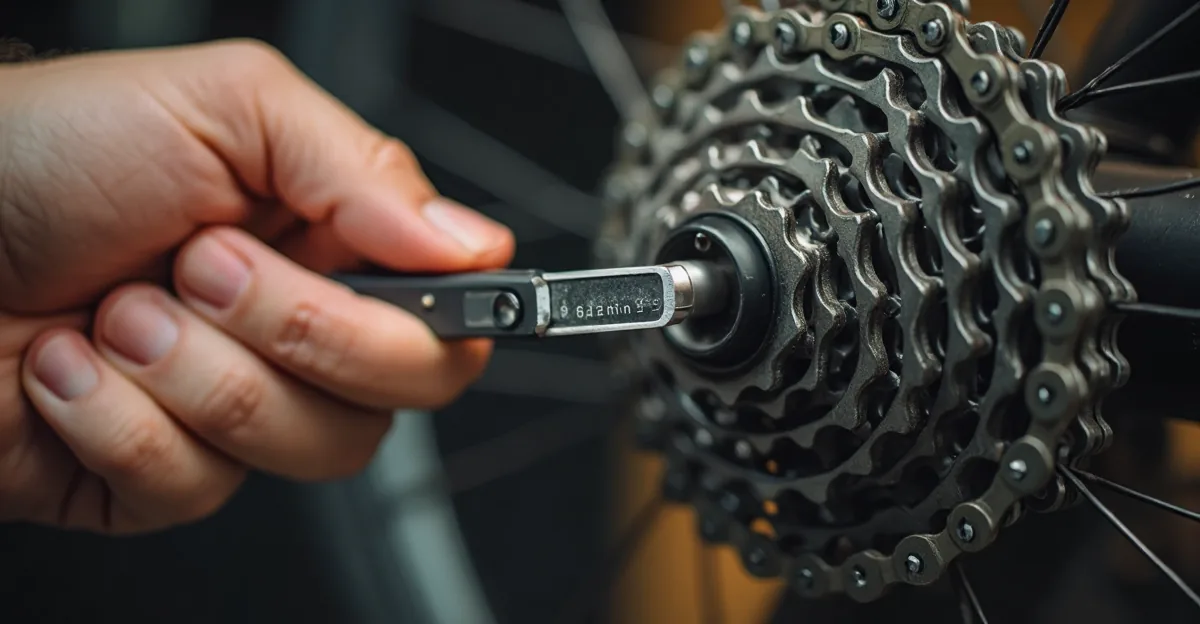
You just put on a new chainring. The chain still reads under the wear limit. And when you backpedal, the chain catches on the ring and, once, half lifts off. The forum answer you are half expecting is "you did something wrong," and the more useful answer is that you did not — the drivetrain is telling you something, and the something is about the set, not about the last job.
This is the post for the moment when the chain will not sit quietly on the ring, when a new chain made the shifting worse, or when you are standing over the bike wondering whether "replace the chain" quietly became "replace the chain, the cassette, and half the crankset." The chain is the part that fails first and the only part you can measure with a tool. The cassette and the chainring fail second and quietly, and they are the expensive parts. Reading the set correctly is what keeps a cheap chain job from becoming a costly one.
The drivetrain wears as a set, and the chain goes first
A bicycle chain has a fixed pitch: 12.7 mm, half an inch, between the centre of one pin and the centre of the next. A new chain measures exactly that, and ten links measure 127 mm. When people say the chain "stretches," they mean something more specific: the pins and the inner and outer plates wear at the roller and pin interface, and the pin-to-pin distance grows. The metal does not stretch. Material is lost, and the chain gets longer.
That extra length is the whole problem. When the chain elongates, its rollers no longer land in the gaps between the sprocket teeth. Instead of seating in the valleys, the chain starts to ride up over the tops of the teeth. That off-centre contact puts the load on the leading edge of each tooth instead of spreading it across the tooth, and over time it scoops the flat top of the tooth into a rounded, hook-shaped profile.
The chain does this to the cassette and the chainring, in that order, because the chain is the moving, loaded, replaceable part and the cogs are the stationary ones it rubs against on every pedal stroke. A chain that is run to the limit will wear a cassette and a chainring noticeably faster than a chain that is replaced at the limit. This is why the cheap part is the one you are meant to watch: replace the chain at the limit and you are buying the life of the more expensive parts. Let the chain go and you are spending that money on the cassette and the ring you just spent the chain on.
Why a new chain can make the problem worse
This is the part that sends people to the wrong shop. The chain catches on the chainring, so you replace the chain. Now it skips under load, or it catches worse, and you think the new chain is bad. It is not. The new chain is the honest one.
The old, worn chain had been riding up over the teeth and, in doing so, wearing them. It also had a little extra length, which let it slip around the worst of the damage. So the wear was being made and hidden at the same time. The moment you put on a new chain, the chain sits the way it is supposed to, and on teeth that have been scooped into hooks there is nothing for it to seat in. It skips, and it catches on the sharp leading edge of a tooth that used to have a flat top.
The backpedal catch you started with is the same family of thing, and it is worth separating. Backpedaling is not a direction a modern drivetrain is engineered to run in: the chain is fed onto the teeth in reverse, with no derailleur tensioning it into the gaps. So any sharpness or any wear shows up more on backpedal than under forward power. A light catch on backpedal that disappears the moment you pedal forward is within normal behaviour for a drivetrain and is not a fault you need to fix. What turns it from normal into a problem is a worn chain or a worn ring, and the two things that most often combine are a chain with a little wear on it and a brand-new chainring with sharp, unbroken-in teeth — which is the exact combination you have.
So the order is: check the chain first, because it is the only part you can measure and it is the cause in most of these cases. Then look at the teeth of the new ring and the cassette. Then decide whether you have a chain to replace or a set to replace. The chain checker answers the first question; the eye answers the second, and the skip test answers the third.
How to measure what you can
The chain is the one part of the set with a real, checkable number. A chain checker is a small go-no-go gauge with slots cut for the wear limits. You put it over the chain and see which slot the chain drops into.
The numbers, stated once and used everywhere on this page:
- 11-, 12- and 13-speed: replace the chain at or just before 0.5% elongation.
- 8-, 9- and 10-speed: replace the chain at 0.75% elongation.
- Single-ring (1x) wide-narrow setups are often given a tighter limit, around 0.65%, because the narrow-wide ring is doing the chain-retention work and a little extra chain length throws it off.
If you do not have a checker and have a set of calipers, the measurement is the same geometry: ten links measure 127 mm on a new chain, so at 0.5% they measure about 127.6 mm and at 0.75% about 127.9 mm. A checker does this for you in seconds, and it is the better tool because a single overstretched link is the kind of thing a short measurement can miss.
Two honest limits on this. First, the checker measures the chain, not the cassette or the chainring. It will tell you the chain is due; it will not tell you the cassette is gone, because the cogs have no comparable read-off. Second, a distance figure is not the signal here. There is no service interval for a chain. How far it lasts depends on lubrication, grit, the load it carries, the drivetrain, and whether it is an e-bike running at higher torque — and on an e-bike the chain reaches the limit sooner and a chain that breaks under load is a worse thing, so the checker matters more on the expensive machine, not less. The lube side of that list — which lube, how often to clean, and how cleaning moves the number — is its own question, and the chain lube post covers it. The elongation is the number, and the checker is how you get it. A notebook, a spreadsheet, or a sticker on the seat tube that notes the distance at each chain fitting is one way to know roughly when to start checking more often, and a maintenance log that counts the distance a chain has ridden and shows the part's remaining life, like Bike Stories, gets you that number automatically — but it is a planning signal for when to look, not a measurement of the chain itself, and it does not replace the checker.
Reading the teeth, where the checker cannot reach
The cassette and the chainring have no gauge, so the measurement is your eye and the behaviour of the chain on them.
Look at the teeth. New teeth sit flat and square: the top of the tooth is a clean, broad surface and the leading edge is sharp and clean. A worn tooth has lost that flat top and rounded over the front, into a hook or a shark-fin shape, with a leading edge that looks thinner and scooped than the base. On a cassette, the middle cogs see the most use, so read them first; the very largest and the very smallest often look new long after the middle is gone. On a chainring the wear is the same profile, and on a 1x narrow-wide ring the narrow teeth are the ones holding the chain in place, so a hooked narrow-wide ring is the one that lets the chain jump.
Then do the skip test. Put the bike up, and shift through the whole range slowly, watching each cog as the chain lands on it. A cog the chain hesitates on, or that it skips on the moment you add load, is the worn one. On a cassette this is usually just one cog, not the whole cluster, and a single skipping cog is the cheapest version of the problem — it is often a cog you can live with for a while, especially if it is one you rarely use. On a 1x ring there is only one ring, so a hooked ring is the whole problem at once.
When the drivetrain has to go as a set
The decision falls out of the three readings, and it comes out one of three ways:
- Chain only. The chain reads within the limit and the teeth of the cassette and chainring read clean. You replace the chain and nothing else. This is the common case, and it is the one that keeps the set alive.
- Chain, with the set still sound. The chain is at the limit and the teeth still read clean. You replace the chain now, on purpose, before it has done the work of hooking the cogs. This is the move that pays for itself over the life of the drivetrain.
- The set, or a cog of it. The chain is at the limit and the teeth read hooked, or a new chain still skips on a cog you can see is worn. Here the chain alone will not fix it, because the new chain has nowhere to seat. You replace the worn cog on a cassette, or the ring on a 1x, and you are into the expensive parts.
The rule of thumb people use to keep the three in proportion is that a chainring survives roughly two chains, and a cassette survives about four — which is another way of saying the chain is the part that is cheap enough to replace before it has done its damage. You do not need to count chains to use it; you need the checker to tell you when the chain is the cheap option, because that is the only window where the decision is still cheap.
The cost framing is the reason the whole post exists. The chain is the cheap part by an order of magnitude, and the cassette and a crankset are the parts that turn a drivetrain job into a real invoice. The checker costs less than a lunch and it is the difference between those two. There are no universal distances, no calendar dates, and no part that tells you it is wearing except by failing on you under load — so the reading, done at the point where the chain is still the cheap part, is the entire job.
The short version
- Measure the chain with a checker at a couple of points: 0.5% for 11-13 speed, 0.75% for 8-10 speed, about 0.65% for 1x. If one link reads high, that link is the one catching.
- Read the teeth of the cassette and chainring: flat, square tops and clean leading edges are good; rounded, scooped, hook-shaped teeth are worn. Start with the middle cogs.
- Run the skip test slowly through the range and find the one cog that hesitates or skips under load.
- Decide from the readings: clean chain and clean teeth is a chain only; a hooked cog or ring that a new chain skips on is the set.
- Keep the distance at each chain fitting somewhere you will find it, so you know when the chain stops being the cheap option.
A drivetrain that is checked at the right moment is a drivetrain where the only thing you ever replace is the chain.
Common questions
My chain reads under the wear limit but it catches on the chainring when I backpedal. What is wrong?
Start by trusting the number: backpedaling is not a direction the drivetrain is designed to run in, so a light catch on backpedal that disappears under forward power is often normal and not a fault. The things that make a real catch are a chain with even a little wear running on a brand-new ring with sharp teeth, a worn cassette or chainring, or a dirty, dry chain. Measure the chain at a couple of points — one overstretched link is usually the one that hangs up — and look at the teeth of the ring and the cassette for the hooked profile. If the chain is clean and the teeth are clean and it only catches on backpedal, that is the drivetrain doing what it does, not something you need to replace.
Do I have to replace the cassette and chainring every time I replace the chain?
No. If the chain is still within the wear limit and the cassette and chainring teeth read clean, you replace the chain and nothing else, and that protects the more expensive parts. The reason people end up replacing the set is that they let the chain run past the limit, and a chain that is past the limit has been wearing the cassette and chainring teeth. The tell that the set is done is not the chain reading high, it is a new chain that still skips or catches on a cog you can see is hooked. Until then, a chain alone is the job.
How do I know the cassette is worn when I cannot measure it like the chain?
You read it by eye and by behaviour. The middle cogs see the most use, so look there first: new teeth sit flat and square, and a worn tooth has rounded over the front into a hook or shark-fin shape, with a leading edge that looks thinner and scooped. Then put the bike up and shift through the range slowly. A cog the chain hesitates on, or skips on when you add load, is the worn one — and on a cassette it is often just one cog, not the whole cluster, which you can sometimes live with. A chain checker tells you the chain; it does not tell you the cassette, so the eye and the skip test are the measurement for the rest of the set.
Why did my new chain make the shifting worse than the old one?
Because the new chain is the correct length and the drivetrain is not. A worn chain had been riding up over the teeth and gradually hooking them; it hid that wear by slipping around it. A new chain seats the way it should, and on hooked teeth it finds nothing to seat in, so it skips and catches where the old chain only muffled. The new chain is not bad and the old chain was not the problem. The chain was the cheap part all along and the cassette and chainring were wearing behind it, which is exactly why the checker is the thing worth doing before the drivetrain is gone.
Drafted with AI, then reviewed and edited by Robert Jensen before publishing.
Stop guessing when you last did that
Bike Stories keeps the service history, the parts, the mileage and the real cost of every bike you own — on your iPhone, with no account. Free for two bikes; Pro is a one-time $9.99 unlock.

Keep reading
Bike wheel rattling: hub and bearing wear, checked in ten minutes
A wheel that wobbles or spins down fast has bearings, not a rim, at fault. Two checks take ten minutes, and the answer decides whether you need grease, a service, or a new hub.
Chain lube: wet, dry, wax, and which one your conditions actually want
There is no universal chain lube. The decision is made by two things — whether the chain meets water, and whether it meets grit — and the wax crowd is right about most of it, wrong about most of the rest.