 Bike Stories
Is a 12 kg (26 lb) bike too heavy for a 5-year-old?
The box says 16-inch and the age says 5, and nothing on the shelf says whether your child can actually hold it up. Here is the one number that settles it, and how to work yours out at home.
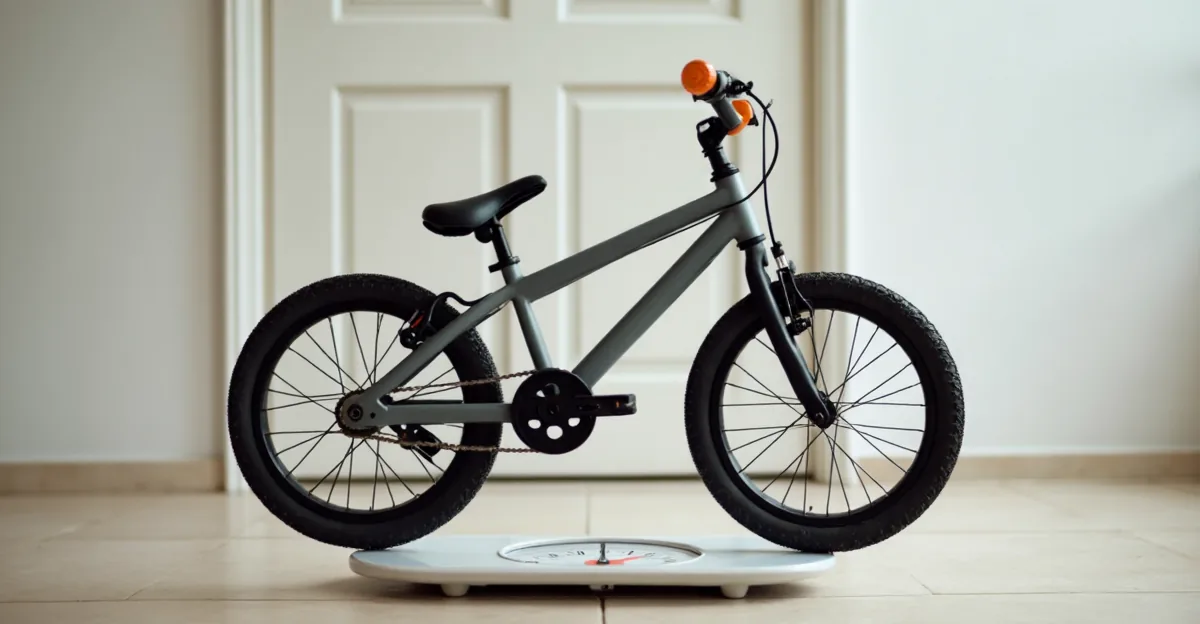
You are standing over a 16-inch bike, the box says it is for a 5-year-old, and nothing on the shelf says whether your child can actually hold it up. Is this bike too heavy for my 5 year old, is the question behind most of those moments, and the answer is a single number you can work out at home with a bathroom scale.
A 12 kg (26 lb) bike under an 18 kg (40 lb) child is a heavy bike by the usual yardstick. This post gives you the yardstick, the arithmetic on the example, and what to do if the bike you have is already heavy.
The rule: bike weight as a share of the child's weight
The figure usually quoted is that a child's bike should stay under about 30-40% of the child's body weight, and lower is better. It is a guide, not a standard or a regulation, and it is not a promise that every bike in a shop meets it. In fact, for a small child most of them do not, and that is the most useful thing in this post. The rule works as a direction to move in and a way to compare two bikes of the same size, not as a pass/fail stamp on a shelf.
Run the child's weight and the bike's weight through it, and the rest of the post is arithmetic.
Worked example: the 12 kg (26 lb) bike
The 12 kg (26 lb) bike in the title sits above the 8-11 kg (18-24 lb) mainstream band for a 16-inch, so it is a heavy bike for its wheel size. Here is what that weight is, against children of different sizes:
| Child | 12 kg (26 lb) bike as a share of the child |
|---|---|
| 16 kg (35 lb) | 75% |
| 18 kg (40 lb) | 67% |
| 20 kg (44 lb) | 60% |
| 25 kg (55 lb) | 48% |
| 30 kg (66 lb) | 40% |
Children of the same age differ a lot, so weigh yours. These are example weights, not averages for a year group. The shape is the point: against a 16 kg (35 lb) child the bike is nearly twice the share it is against a 30 kg (66 lb) one, and it only reaches the 30-40% band at the very end of the table.
Flip it: how heavy a child does each bike need?
Turn the same calculation around and ask what child a given bike actually needs:
| Bike | Child of roughly |
|---|---|
| 6 kg (13 lb) | 15-20 kg (33-44 lb) |
| 8 kg (18 lb) | 20-27 kg (44-59 lb) |
| 10 kg (22 lb) | 25-33 kg (55-73 lb) |
| 12 kg (26 lb) | 30-40 kg (66-88 lb) |
So an 18 kg (40 lb) child is looking at a bike of about 5.4-7.2 kg (12-16 lb). That is the honest result, and it is why only the lightest bikes get close for a small child. The market ranges, stated as segments rather than for any one bike, are the context: light 16-inch bikes run about 5-6 kg (11-13 lb) and the mainstream ones about 8-11 kg (18-24 lb). The 12 kg (26 lb) bike sits above that mainstream band, so it needs a child of 30-40 kg (66-88 lb) to sit inside the 30-40% band — an older child, not a 5-year-old.
What the extra weight costs a small child
Weight does not show up as a number on the bike. It shows up as the ride. The problems all sit at low speed, where a child has the least reserve: starting from a standstill, stopping before the corner, holding the bike up at a stop, and catching it when it tips. The heavier the bike, the harder each of those is, and the more a child who is still learning to ride has to do without thinking about it. A heavier bike also carries more momentum, so it asks more of a small hand on the brake lever. None of this needs a figure to be true: it is what a child feels every time the bike slows down.
Why kids' bikes are heavy, and what the price buys
The weight has a few common causes:
- A steel frame instead of aluminium
- Steel rims instead of alloy
- Thick tyres and tubes for the tread
- A suspension fork
- Mudguards, a chain guard, a kickstand
- A basket, a bottle cage, stabilisers
A lighter bike costs more mostly for the frame and the wheels, and those are the two heaviest things on it. If the difference between two bikes is a kilo or two, the money is usually in the alloy frame and the lighter rims, which is exactly where the child will feel it.
How to weigh a kid's bike
You do not need a workshop to get the number. A bathroom scale and a bit of arithmetic:
- Weigh yourself empty. Step on the scale alone, without the bike, and note the number.
- Weigh yourself holding the bike. Stand on the same scale holding the bike upright, and note the higher number.
- Subtract. Take the empty weight off the combined weight, and the difference is the bike's weight.
- Weigh the child. Step the child on the scale, or use the same two-weigh method for them.
- Divide. Divide the bike's weight by the child's weight to get the share.
Weigh the bike the way it will be ridden, pedals and stabilisers on, and note which accessories the number includes. If a listing states a weight, check whether it includes stabilisers and accessories, and ask if it does not say. Bathroom scales are coarse, so rounding to the nearest 0.5 kg (1 lb) is fine, and two readings is better than one.
If the bike you have is already heavy
A bike that is a little heavy for the child for a short stretch is a handling problem, not a disaster. Some of it can come off honestly: the stabilisers when the child is ready, the basket, the bottle cage and other bolt-ons, and the kickstand if it is not used. The first pedal bike post is the one that asks when the stabilisers come off.
Do not remove the brakes, the reflectors or the chain guard to save grams, and leave any lighter wheels, brakes or component swap to a shop. Reflector and lighting rules vary by country, and a brake that stops less to be lighter is a safety change, not a weight change.
Three checks say more than the number does, and they are practical tests for this child on this bike, not a standard: can the child stand the bike up unaided after laying it down, can they wheel it alongside them, and can they start from a standstill without wobbling? A failure on any of them is information about this child and this bike, not a verdict on the parent.
Three children, three answers
The rule lands differently at three points a family will meet:
- A 3-year-old of about 14 kg (31 lb) on a balance bike: at 30-40% that is roughly a 4.2-5.6 kg (9-12 lb) bike. The child has to lift, turn and stand the bike up with no pedals to help, so every kilo is felt in the handling. 14 kg is an example, not an average.
- A 5-year-old on a 16-inch bike, the main example here, where the 12 kg (26 lb) bike is at 67% of an 18 kg (40 lb) child and the lighter ones are the ones to look at.
- A 9-year-old on a geared 24-inch bike, where the child is heavier, the rule is harder to meet, and lighter is worth paying for. Take a stated 30 kg (66 lb) child at 30-40%, and the bike sits at 9-12 kg (20-26 lb).
Tie each to the child's actual weight, not the age on the box, and the sizing post has the measurement. Do not buy a bigger frame to grow into; the growing room belongs in the seatpost and the stem, and a frame two sizes up is a bike the child cannot put a foot down on or brake.
Write the numbers down
The child's weight and the bike's weight both change every few months, and neither one is the sort of number you can recall in six months. A notebook, a note in the phone, a sticker on the frame, any of these work. An app like Bike Stories keeps a reference setup sheet next to each bike's service history, so the number lives somewhere other than memory.
The short version
- Weigh the child and weigh the bike, the two-weigh subtraction above.
- Divide the bike's weight by the child's weight to get the share.
- Under about 30-40% is the direction, and lower is better.
- When two bikes are the same size, take the lighter one.
- Run the three handling tests; a failure is information, not a verdict.
- Take off stabilisers, basket, bottle cage and kickstand when you can, and leave any component swap to a shop.
Common questions
How heavy should a kids bike be?
Under about 30-40% of the child's body weight, and lower is better. For an 18 kg (40 lb) child that is a 5.4-7.2 kg (12-16 lb) bike. The lightest 16-inch bikes run about 5-6 kg (11-13 lb) and the mainstream ones about 8-11 kg (18-24 lb), so for a small child only the lightest band gets close. The rule is a guide and a way to compare two bikes, not a pass or fail.
Why is my kid's bike so heavy?
Usually the frame and wheels. Steel frames and steel rims weigh more than aluminium, and thick tyres, a suspension fork, mudguards, a chain guard, a kickstand and a basket each add on. A 16-inch bike that comes in at 12 kg (26 lb) is above the 8-11 kg (18-24 lb) mainstream band, and the extra weight shows up in starting, stopping and catching the bike when it tips.
How do I weigh a kid's bike at home?
Weigh yourself on a bathroom scale, then weigh yourself holding the bike, and subtract. Do the same for the child, or step the child on the scale. Weigh the bike the way it will be ridden, pedals and stabilisers on, and note which accessories the number includes. Bathroom scales are coarse, so rounding to the nearest 0.5 kg (1 lb) is fine.
Drafted with AI, then reviewed and edited by Robert Jensen before publishing.
Stop guessing when you last did that
Bike Stories keeps the service history, the parts, the mileage and the real cost of every bike you own — on your iPhone, with no account. Free for two bikes; Pro is a one-time $9.99 unlock.

Keep reading
Kids' bikes: five things worth paying for
A kids' bike spec sheet is full of features, and most of them are marketing. Five of them are real, and every one takes a minute to check in the shop.
What size bike a kid actually needs — inseam and standover, not age
Age charts sell bikes; they do not fit them. What decides the size is the child's inseam, the standover gap, and whether they can reach and squeeze the brake levers.